
This site serves as the archival home for Gandy Dancer. For current issues and submission information, visit www.gandydancer.org.
Gandy Dancer is a literary magazine, available online and in print, that publishes fiction, poetry, creative nonfiction, and visual art. Edited by a rotating staff of students at SUNY Geneseo, Gandy Dancer is published twice yearly.
Current Issue: Volume 14, Issue 1 (2025)
Dear Readers,
In our roles as managing editors and production assistant, our hope was to create a space where we felt comfortable building close relationships with each other, our peers, and you—the reader—bolstering the broader creative community that Gandy Dancer has embodied for thirteen years. As the experiences we get from this class are inextricably linked to the world around us, we felt it was crucial in times like these to build strong bonds with each other that reflected the relationships and conversations we want to have outside of Welles 216. We chose to do this by way of genre group bonding—going out to coffee and having movie nights—with the goal of getting to know each other more intimately. As we were reviewing pieces this semester, we realized that our contributors were occupied with similar questions about their connections to place, family, self, and even our political climate. And now, we share them with you.
Lori Yamond’s braided essay “The Womb Shaped Fruit” investigates the intricate ties that bind us to the earth, to our mothers, and to ourselves. Balancing individual threads that discuss the role of the fig in the lifespan of the wasps it hosts and the struggle to maintain individuality in the midst of motherhood, Yamond asks us to confront ourselves: “We wish to turn a blind eye to the pain ravaging the woman whose motherhood has labeled her as resilient. Maybe this blind eye has given us the courage to be the ones to cause the ravaging pain…” By exploring the unique harm borne by those, human and otherwise, who create and sustain life, Yamond prompts a deeper conversation about our relationship to an environment in flux.
The work published here plunges deeper into the typical connections people have and breaks them down piece by piece, revealing why we build relationships in the first place. For example, in Kira Hook’s short story “Look-ing Down From Parliament Hill,” the narrator reflects on her miscarriage and how it affects her relationship with herself, with what was lost, and the partner with whom she shares this lost child. Perhaps in connection with Sylvia Plath’s poem, “Parliament Hill Fields,” which was written a week after Plath’s miscarriage, Hook places us in the narrator’s thoughts as “she swallows the name she gave to tissue, mucus, and bloody cells.” The image of blood and pieces of the body highlight the dissonance and desire for connection the narrator has to what was lost. We even see her recognize her feelings about her husband in the moment and how “her countenance is fractured under her husband’s gaze.” Hook brings this moment to life in just one page, and in this brevity, she reveals something profound about our narrator and her conception of her loss, underscoring the raw reality of grief and the complex reasons we seek connection in such difficult times.
The art included here also examines the need for relationships and con-nection, as well as the many different places one might find it. Michaela Chittenden’s “The American Dream” transports us to a fifties-style American living room, where a family is watching Elvis performing on the television. The smile of the woman sitting on the floor gives us a sense of hope and that even something as simple as watching TV can bring a whole world together. Natalie Vazquez-Martinez’s colorful self portraits, playing with mediums as varied as oil on canvas in “Me” and “Moi,” and painted wood blocks assem-bling a still more abstract face, provide a sense of the strange and everchang-ing nature of one’s relationship to self.
This issue doesn’t just examine personal and interpersonal relationships; it also considers dynamics of authority and how they affect our lives as a whole. In the midst of the current administration, the longest government shutdown in U.S. history, and countless headlines regarding our political landscape, individuals have had to reassess their relationship with the government, their communities, and the planet. The poets in this issue have put themselves in the epicenter of current events, both in the world and their own backyards, to deliver a reminder of our place in it all. Michael Crowley’s poem “Subtropic” explores climate change through memories of enjoying native fruits in New York that will no longer thrive in the state’s new “humid subtropical climate.” Monty Cooke’s “Zainab Abu Halib” tells of five-month-old Zainab Abu Halib, a Palestinian “baby who will never be a child’’ who starved to death in Gaza. In “My Method to Slightly Mitigate the Harm of Wealth Inequality” Owen Penhollow brilliantly, and comedically, outlines how the 1% could really benefit the rest of us by naming buildings after “the most heinous rich person” so we might get a discount out of it.
We want this issue to serve as a place where you can see and find yourself. As the new stewards of the magazine, we came into our roles seeing how the growing shadow of censorship has seeped into our everyday lives, building anxiety over a possible dark future for our journal and others like it. Because of this, and in addition to recent cuts to education and the arts, we knew it was even more integral to continue to allow Gandy Dancer to be a place where all voices, experiences, and experiments can find a permanent and unwaver-ing home. “Elinguation” by Monty Cooke stands as a pillar, a reminder that “The tongue is mightier than the sword (…) if you know what you fight for.” It’s a scary world out there, full of adversity that threatens to consume us. However, this journal affirms that even in the face of difficult dynamics, it is crucial to find a safe space to confront those issues—this is ours. We hope you love 14.1 as much as we do, and maybe even find a sense of home in it too. We can’t wait to see you again next semester.
Always in your corner,
Nina Avallone-Serra, Sonia Horowitz, and Paige Loucks
Poetry
What Holds Me, What Roars in Me
Jasmeen Kaur, SUNY Old Westbury
When You Forget Who You Are (addressed to younger me)
Jasmeen Kaur, SUNY Old Westbury
Smelling Salts
Alyssa Dawson, SUNY Geneseo
Fringes of Photographs
Abigail Halbert, SUNY Fredonia
Mother and the Monsters
Dan Owen De Vera, University at Buffalo
Things Big and Small (The Seed from Which I Grew)
Sheila Verkaik, SUNY Purchase
Cultuurschok: Hoe je Spreekt Nederkaans
Sheila Verkaik, SUNY Purchase
Zero Food Waste
Buzz Kozak, SUNY Purchase
40mg Omeprazole, Once Daily
Buzz Kozak, SUNY Purchase
My 4th Annual Birthday Political Fundraiser
Buzz Kozak, SUNY Purchase
In the Face of Nothing Else
Rey Davis, Stony Brook University
malpractice
Belle Elyse, SUNY Purchase
The Misfortune Family’s Limerick
Paulina Bargnesi, University at Buffalo
My Method to Slightly Mitigate the Harm of Wealth Inequality
Owen Penhollow, University at Buffalo
Lover’s Poem
Ana Paul, University at Buffalo
Zainab Abu Halib
Monty Cooke, SUNY Fredonia
Elinguation
Monty Cooke, SUNY Fredonia
Fiction
Looking Down from Parliament Hill
Kira Hook, Stony Brook University
His Own Eyes
Noah Banas, SUNY Geneseo
Finertipped in Wait
Katerina Ronconi
Confessions
Stephen Piazza, SUNY Albany
Creative Nonfiction
Old Haunts
Archer Maduro, SUNY Geneseo
The Womb Shaped Fruit
Lori Yamond, SUNY Old Westbury
Art
Heavy Eyes
Jade Maracic, Fashion Institute of Technology
Soul Snippets (1)
Victoria Stiver, SUNY New Paltz
i miss you
Caitlin Andrejova, University at Buffalo
Loving Memory
Caitlin Andrejova, University at Buffalo
Quetzalcoatl
Gabriella Ferri, SUNY Delhi
Guardian Angel
Sawyer Taylor Ramsamooj
how do you want me?
Sawyer Taylor Ramsamooj
Self-Portrait
Natalie Vazquez-Martinez, SUNY Plattsburgh
Bring Him Home
Michaela Chittenden
The American Dream
Michaela Chittenden
Mold Study
Victoria Stiver, SUNY New Paltz
I Know It Exists Because I Feel It With You
Victoria Stiver, SUNY New Paltz
Maliboo (Little Brother)
Shadae Walker, SUNY Delhi
Nervous Condition
Emma Eager, SUNY Purchase
Metamorphoses
Emma Eager, SUNY Purchase
The Grand Scheme of Things: A Review
Paige Louks, University at Buffalo
Postscripts
Seagull Motif (Violet and Green)
Jesse Curran, SUNY Old Westbury
"Landscape at Cagnes“
Jesse Curran, SUNY Old Westbury
"Partly Cloudy"
Jesse Curran, SUNY Old Westbury
Reviews
Portraits of Struggle: A Review of Amina Gautier’s At-Risk
Sarah N. Lawson
Interview
Interview with Sarah Cedeño
Sonia Horowitz, SUNY Geneseo
Full Issue
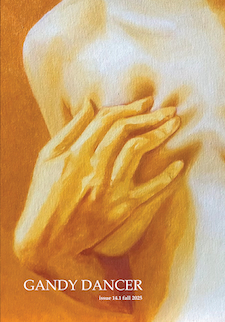
Gandy Dancer 14.1 (Fall 2025)
Gandy Dancer
Editorial Team
- Managing Editors
- Sonia Horowitz, Paige Loucks
- Production Assistant
- Nina Avallone-Serra
- Fiction Editor
- Sophia Imbriaco
- Creative Nonfiction Editor
- Madelyn Perry
- Poetry Editors
- Ella Singer, David Sweeney
- Fiction Readers
- Hannah Anagnostakos, Ryan Eck, Julia Gartley, Daisy Sheldon, Aubrey Stout Peters, Jack Towns
- Creative Nonfiction Readers
- Abigail Axton, Nat Baron, Kayla Clark, Allie Konsevitch, Emily Sneider, Adanna Wolfr
- Poetry Readers
- Hailey Bilby, Taya Markham, Regan Russell, Alex Seney
- Faculty Advisor
- Rachel Hall
- Production Advisor
- Allison Brown
- Social Media Manager
- Liberty Dodds
- Advisory Editors
- Sonya Bilocerkowycz, Dan DeZarn, Lucia LoTempio, Mehdi Okasi (Purchase), Michael Sheehan (Fredonia), Lytton Smith, Kathryn Waring
- Special thanks to:
- the Parry family and Sarah Cedeño